
Published by Vera, which makes product identity tags, certificates and software. Vera's own role is set out under 'Where Vera fits'.
This is for general information and is not legal advice.
6 min read
Some digital product passports are built on blockchains. What an NFT actually proves about a physical object, what a tag and certificate prove, and why that difference matters more than the ledger.

Listen to this article
Every brand that looks at digital certificates for its products meets the same question sooner or later: should the certificate be a non-fungible token (NFT)? Several of the digital product passports offered to luxury houses are built on blockchains, by industry consortia and by token-based passport providers, and the pitch is persuasive. A token cannot be forged, the ledger cannot be quietly edited, and the record outlives any one company.
Vera ties each certificate to its object with a tag and keeps the record for the brand. That is a design decision, and this piece sets out the reasoning. It is not an argument that blockchains are insecure. It is an argument about what each approach actually proves about a physical object.
An NFT is an entry in a ledger. Under ERC-721 (Ethereum Request for Comment 721), the Ethereum standard for non-fungible tokens, a contract tracks which address owns each token. The description of what the token stands for is an optional extension: a Uniform Resource Identifier (URI) that may point to a JavaScript Object Notation (JSON) file kept somewhere else. The standard says NFTs can represent ownership over digital or physical assets, and represent is the word doing the work.1
What the ledger shows with certainty is narrower. It shows that a particular wallet controls a particular token entry, and the history of transfers between wallets. The overview of blockchain technology from the US National Institute of Standards and Technology (NIST) is explicit that a transaction signature links transactions to the holders of private keys but provides no way of associating real-world identities with them. A wallet is not a person, and a token is not a watch.2
The harder problem sits outside the ledger. NIST calls it the oracle problem: a blockchain can record data about the real world, but there may be no way to determine whether that data reflects real-world events. Its own example is a purchase of a physical item, where nothing within the blockchain can show whether the shipment ever took place.2
For products, the consequence is plain. A token can be minted correctly, held in the right wallet and transferred flawlessly while the bag on the table is a copy. The ledger secures the record; it does not bind the record to the object. Something physical has to do that, and in practice it is a tag on the product. Once a tag is doing the binding, the question that matters is what the tag can prove, and the answer does not depend on where the record is stored.
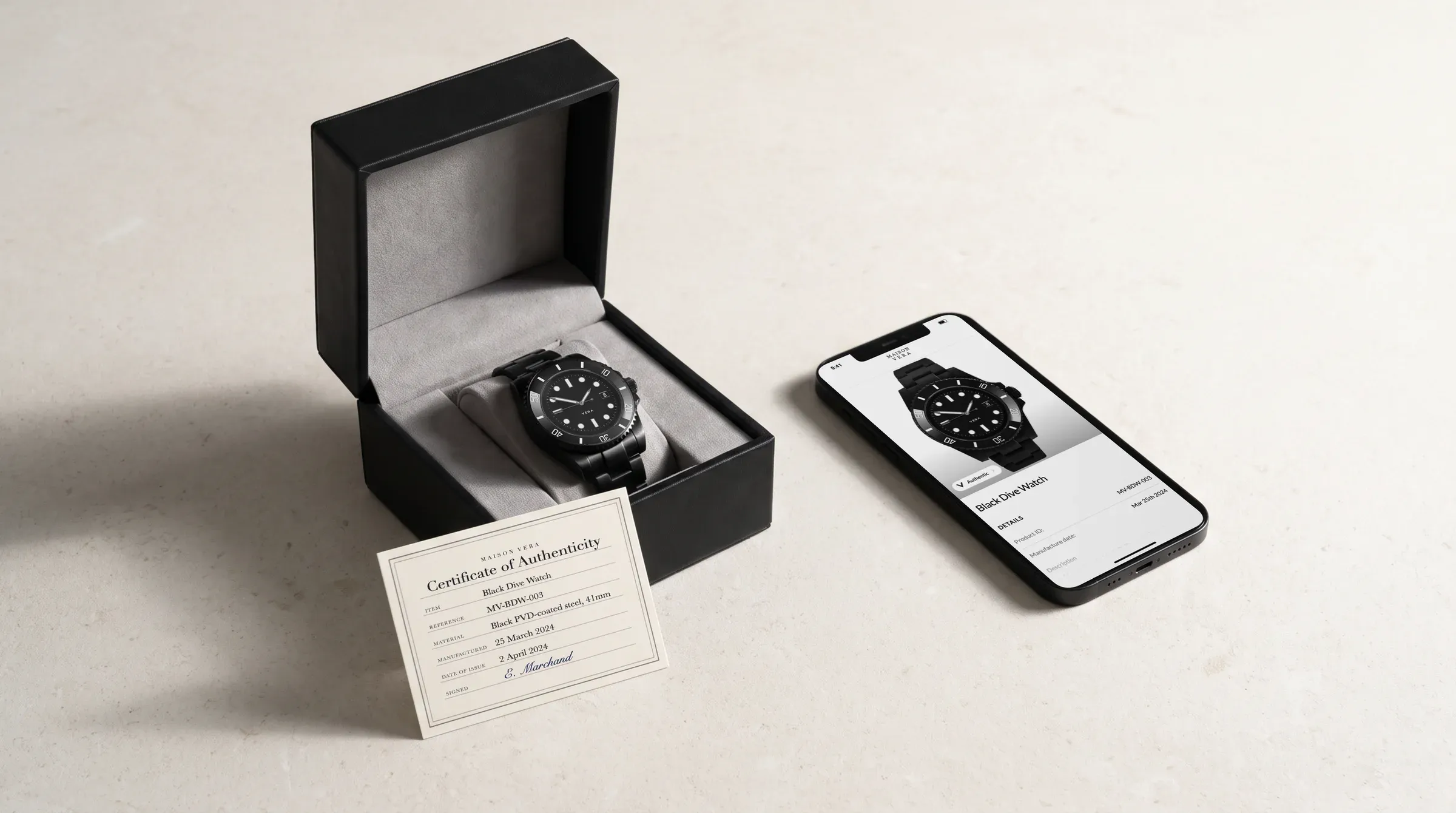
A Vera tag goes into the product where it is made: placed inside a watch behind the dial, hidden behind a handbag's logo or in a fabric patch, or sewn into a garment's label. Behind the tag sits a certificate that belongs to that one item.
Secure tags of this kind do more than hold a number. Each time one is read, it computes a fresh cryptographic code with a key that cannot be read off the tag. A tap therefore produces evidence about the object in hand, not about a web address. A link that has been copied or screenshotted opens the certificate without the verified state, and a tap that replays an old code is recorded as invalid and shown on the certificate.
Together, a verified tap and its certificate answer three questions a token cannot answer by itself.
Comparison
What a token proves, and what a tag and certificate prove
An NFT
What it shows
Which wallet controls a token entry, and its transfers between wallets
What ties it to the object
Nothing within the ledger; an optional URI may point to a file kept elsewhere
What an owner needs
A wallet, controlled by a private key
If the key or the item is lost
A lost key loses the asset; a stolen key gives the thief full access
A tag and certificate
What it shows
Which object this is, who made it, who owns it now, and every transfer, resale and scan
What ties it to the object
A tag fitted in production that computes a fresh code each time it is read
What an owner needs
A phone: the certificate opens in its browser
If the key or the item is lost
The owner marks the item lost or stolen, and anyone who taps it sees that status
A comparison of an NFT and a tag with its certificate. An NFT shows which wallet controls a token entry and the transfers between wallets; nothing within the ledger ties it to the object, and an optional URI may point to a file kept elsewhere; an owner needs a wallet controlled by a private key; and a lost key loses the asset, while a stolen key gives the thief full access. A tag and certificate show which object this is, who made it, who owns it now, and every transfer, resale and scan; a tag fitted in production ties it to the object by computing a fresh code each time it is read; an owner needs only a phone, as the certificate opens in its browser; and if the item is lost or stolen, the owner marks it, and anyone who taps it sees that status.
Tokens also ask something of owners that few luxury buyers expect. A wallet is controlled by a private key, and NIST spells out the consequence: if a user loses the key, any digital asset associated with it is lost, and if the key is stolen, the thief has full access. For a token standing in for a watch, a forgotten recovery phrase means a lost provenance record, and a phished one means a stolen one.2
A certificate can work the way owners already expect. Opening it takes a phone, not an app or a wallet. Ownership moves when the current owner sends the certificate on with a code and the recipient accepts. An owner who sells can complete the sale inside the certificate, so the money and the ownership record move together. If an item is lost or stolen, the owner can mark it, and anyone who taps it afterwards sees that status. Each owner also decides whether their step appears in the public history.
Process
How ownership moves with a certificate
Tapped with a phone
The certificate opens in the phone's browser.
Sent on with a code
The current owner sends the certificate to the next.
Accepted
Ownership moves when the recipient accepts.
On the record
Written to the same certificate; each owner decides if their step is public.
A four-step process. First, the item is tapped with a phone and its certificate opens in the phone's browser. Second, the current owner sends the certificate on with a code. Third, ownership moves when the recipient accepts. Fourth, the transfer is written to the same certificate, and each owner decides whether their step appears in the public history. An owner who sells can complete the sale inside the certificate, so the money and the ownership record move together.
Even the feature most often cited for tokens in resale, the built-in royalty, has proved weaker than it sounded. The Ethereum royalty standard states that payment must be voluntary, and in August 2023 OpenSea announced it would make creator fees optional. A brand that wants a share of resale needs agreements with whoever runs the sale, with or without a token.3,4
The best argument for a ledger is not security. It is independence. A record kept by one company depends on that company: its systems, its honesty and its survival. A shared ledger, the argument goes, keeps the record intact whatever happens to any single operator.
It deserves a straight answer, and part of it holds. Where many parties who do not trust one another must all write to the same record, and no one can be its operator, a ledger can be the right tool. But a ledger is not free of operators either. NIST lists the idea that no one controls a blockchain among its misconceptions: permissioned networks are run by an owner or consortium that can replace blocks by legitimate means, and permissionless ones are steered by their developers and publishing nodes. It also notes that a defunct blockchain would not be suitable as a historical record.2
A product certificate is not the many-writers case. The authority on whether a brand made an object is the brand. What matters is that the brand, rather than its vendor, controls the record. With Vera, the brand owns its data and can export it in full, so its record of its products is not locked inside any one provider.
Whatever sits behind it, a product certificate should be judged on what it proves. Five questions separate a strong one from a weak one.
Vera's answer is a certificate: a record kept for the brand and tied to the object by its tag. Brands that want an extra, independent store of record can have Vera connect a blockchain, so each certificate is also kept with a third party for posterity, and what the certificate does for the brand and the owner stays the same.
Connections
One certificate, and what it does for each party
A hub diagram with the item's certificate at the centre: a record kept for the brand and tied to the object by its tag. Around it, five parties. The object, whose tag signs each read with a key it never reveals. The brand, which owns the record and can export it in full. The owner, who holds the certificate without a wallet or new software. A buyer, who taps the item to see which object it is and who owns it now. And, optionally, a third party that keeps an independent copy on a blockchain, for posterity.
A token proves who controls an entry in a ledger. A tag and certificate prove which object you are holding, who made it and who owns it now. For a physical product, the second set of answers is the one buyers, owners and brands actually need.
Published by Vera, which makes product identity tags, certificates and software. Vera's own role is set out under 'Where Vera fits'.
This is for general information and is not legal advice.
New articles, interviews and product news from Vera.
Unsubscribe any time. We never share your email.

Perspective, 7 min read
Explainer, 8 min read

Perspective, 4 min read