
Published by Vera, which makes product identity tags, certificates and software. Vera's own role is set out under 'Where Vera fits'.
This is for general information and is not legal advice.
8 min read
A certificate of authenticity vouches for one item: what it is, who made it and who stands behind the claim. On paper it can be copied or separated from the item; bound to a tag, it stays with it.
Listen to this article
Definition
A certificate of authenticity is a document stating that one item is genuine and identifying it: what it is, who made it, and who is making the statement. It is also called a COA, a certification of authenticity, a letter of authenticity or an authenticity letter. The format runs from a signed card to a bound report, but the job is the same.
A certificate is a promise, not proof in itself. It is worth what its issuer is worth, and only while it stays with the item it describes. Paper certificates tend to fail on the second condition, and sometimes on the first.
Contents
There is no single legal template, but where the law does set one out, it asks for much the same things. California requires an art dealer selling fine prints, photographs or sculpture casts made in multiples to furnish a certificate of authenticity. It must disclose the artist, the artist's signature, the medium, whether the piece is a reproduction, when it was produced, the use of the plate and the number of pieces in a limited edition.1
For autographed sports and entertainment memorabilia sold for $50 or more, California requires the dealer to give a written express warranty of authenticity, which may be part of the invoice. It must give the dealer's legal name and address, the date of sale and the price, describe the item and name the signer, and say whether the signing happened in the dealer's presence. It must also list the information the dealer relied on, any serial number that matches a number printed on the item, and whether the item came from a third party. The dealer keeps a copy for seven years.2
Taken together, a sound certificate of authenticity states:
Issuers
Four kinds of issuer are common, and their certificates carry different weight.
In each case the certificate is a claim by someone about something. The further the issuer stands from the making of the item, the more the certificate rests on judgment rather than knowledge.
Spectrum
The further the issuer stands from the making, the more a certificate rests on judgment
What the certificate rests on
The maker or brand
Knows what it made, and which serial numbers it issued.
The artist
The person who made the piece, or the artist's studio.
The dealer, gallery or auction house
Vouches for what it sells; California puts the duty on the dealer for prints and signed memorabilia.
A third-party authenticator
Examines the item after the fact; the certificate records an opinion.
A spectrum of what a certificate of authenticity rests on, from knowledge of the making to judgment after the fact. At the knowledge end, the maker or brand, which knows what it made and which serial numbers it issued, and the artist, the person who made the piece, or the artist's studio. In the middle, the dealer, gallery or auction house, which vouches for what it sells; California puts the certificate or warranty duty on the dealer for prints and for signed memorabilia. At the judgment end, a third-party authenticator, which examines the item after the fact, so its certificate records an opinion.
Paper
Paper has four weaknesses, and each matters more as an item's value rises.
Holograms, seals and security paper make a certificate harder to copy, which is why a certificate of authenticity hologram is so common. Those parts are counterfeited too. In the global customs data of the Organisation for Economic Co-operation and Development (OECD) and the EU Intellectual Property Office (EUIPO) for 2020–21, 20% of seizures involved packaging, labels and other authentication components, such as holograms or QR codes. Counterfeiters ship them apart from the goods and assemble the fakes near the market.3
US customs data shows the same trade. In fiscal 2025, the top ten counterfeit commodities by quantity at US Customs and Border Protection (CBP) included 822,653 labels and tags and 4,206,696 items of packaging and boxes.4
In numbers
The parts that make a product look genuine are counterfeited too
20%
Of global customs seizures, 2020–21
Involved packaging, labels or authentication components such as holograms or QR codes
822,653
Counterfeit labels and tags
Seized by US customs in fiscal 2025
4,206,696
Counterfeit packaging and boxes
Seized by US customs in fiscal 2025
Three figures. In global customs data for 2020–21, 20% of counterfeit seizures involved packaging, labels or other authentication components such as holograms or QR codes. In fiscal 2025, US customs seized 822,653 counterfeit labels and tags, and 4,206,696 counterfeit items of packaging and boxes.
Digital
A digital certificate keeps the same statements and changes what they are attached to. Instead of a document that travels beside the item, it is a record for that one item, opened by tapping a secure tag fitted in the item itself. The tag is what binds the record to the object.
ISO's guideline on authentication solutions for material goods, ISO 22383:2020, sets the aim as establishing a good's authenticity and integrity throughout its entire life cycle. A paper certificate speaks for one moment, the day it was issued. A digital certificate can be checked at every hand-off, and it can keep a record of each one.5
Three things follow. The record is per item, so two units of the same model each have their own. Ownership can transfer, so the certificate names the current owner rather than the first. And the record has a history: each scan, transfer and resale is added to it, so the certificate grows with the item instead of aging.
A secure tag also changes what copying achieves. It produces a fresh cryptographic code each time it is read, so a photo of the certificate or a forwarded link replays an old code and is not shown as verified. No identity system makes copying impossible, but a copy of the link is no longer enough to pass for the original.
Comparison
A paper certificate travels beside the item; a digital one is bound to it
Paper certificate
How it stays with the item
Kept beside the item, and easily separated from it
If it is copied
A good copy looks the same as the original
If it is lost
Usually gone for good, and hard to replace
When the item is sold
Still names the first buyer, if anyone
Its history
Fixed on the day it was issued
How it is checked
By eye, or by contacting the issuer
Digital certificate bound to a tag
How it stays with the item
Opened by tapping a tag fitted in the item
If it is copied
A copied link replays an old code and is not shown as verified
If it is lost
The record stays with the item, reached through its tag
When the item is sold
Ownership transfers to the new owner
Its history
Each scan, transfer and resale is added
How it is checked
A phone tap, in the phone's own browser
A comparison of a paper certificate of authenticity and a digital certificate bound to a tag. A paper certificate is kept beside the item and is easily separated from it; a digital one is opened by tapping a tag fitted in the item. A good copy of paper looks the same as the original; a copied link to a digital certificate replays an old code and is not shown as verified. A lost paper certificate is usually gone for good; a digital record stays with the item, reached through its tag. When the item is sold, paper still names the first buyer, if anyone; a digital certificate transfers ownership to the new owner. Paper is fixed on the day it was issued; a digital certificate adds each scan, transfer and resale. Paper is checked by eye or by contacting the issuer; a digital one by a phone tap in the phone's own browser.
Checklist
Whether it is on paper or digital, a certificate that holds up does these things:
Where Vera fits
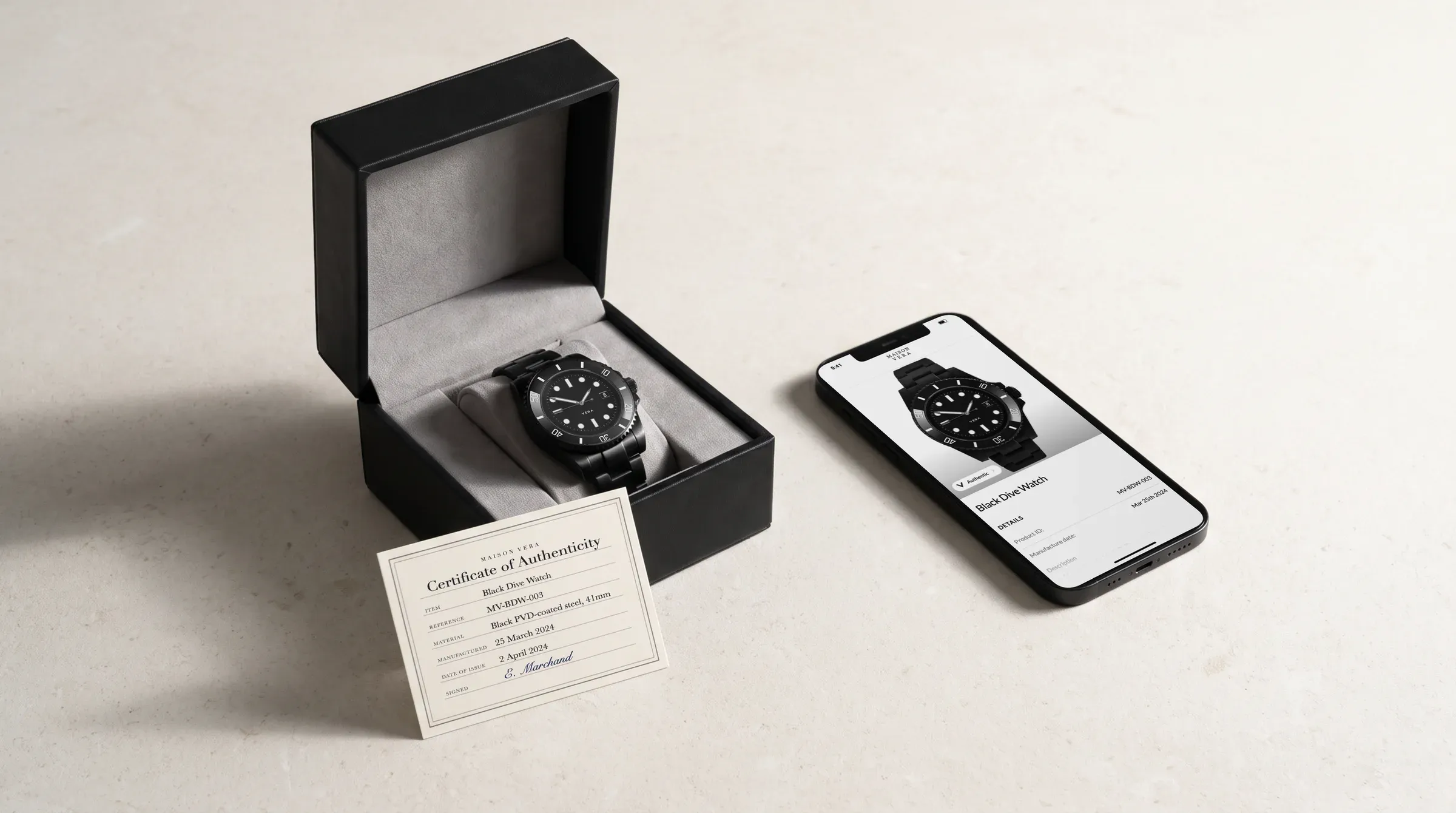
Vera Certificates are digital certificates of authenticity bound to Vera Tags. For most brands, the tag goes in at manufacture: in a watch it sits inside, behind the dial. A box of tags can be bound to its products before it ships, so each item has its certificate from the factory, before the first sale, and keeps it through every owner after.
Take the Black Dive Watch from Maison Vera, the demo house on Vera's platform. Anyone can tap it to open its public certificate and see that it is authentic, on any phone, with no app. The certificate carries the brand's logo and colors. Ownership is recorded on it and travels with the watch, sale after sale, and it keeps the watch's ownership history from the brand through every owner since. Every scan is recorded with where it happened, and a copied link is recorded as an invalid scan rather than shown as verified.
Owners keep control. An owner can hold the certificate without their identity being shown, and share links can be revoked after they are sent. An owner can pass the watch on with a code, and on acceptance the ownership record changes hands. If the watch is reported lost or stolen, anyone who taps it afterwards sees that status. A watch and its strap can be handled as a group, one parent certificate with a child for each part. If a tag is damaged in a repair, it is replaced and the certificate is rebound, with its whole history kept.
Connections
The anatomy of a Vera certificate, on the Black Dive Watch
A hub diagram of a Vera certificate, using Maison Vera's Black Dive Watch. At the center, the watch's certificate, bound to a tag behind the dial before the box ships, with every scan recorded with where it happened. Around it, six parties and parts. Anyone who taps sees on any phone that the watch is authentic, or that it has been reported lost or stolen. The brand's logo and colors are on the certificate, and it keeps the ownership history from the brand through every owner since. The owner is recorded on it, can hold it without their identity being shown, and can revoke share links. The next owner receives the watch with a code, and on acceptance the ownership record changes hands. The strap is handled as a group with the watch: one parent certificate, with a child for each part. If a repair damages the tag, it is replaced and the certificate rebound, with its whole history kept.
Published by Vera, which makes product identity tags, certificates and software. Vera's own role is set out under 'Where Vera fits'.
This is for general information and is not legal advice.
Questions

Perspective, 6 min read

Perspective, 4 min read

Explainer, 10 min read