
Published by Vera, which makes product identity tags, certificates and software. Vera's own role is set out under 'Where Vera fits'.
This is for general information and is not legal advice.
4 min read
Forgers have better tools than ever, and a paper certificate is often easier to copy than the item it vouches for. How memorabilia authentication is changing, and why the record should travel with the object.

Listen to this article
The appeal of memorabilia, whether a signed baseball, a rare concert poster or a vintage trading card, is as strong as ever. Verifying it has become harder. Better printing, editing software and image-generation tools have put convincing fakes within reach of more people, and the paperwork meant to prove an item genuine is often easier to copy than the item itself. This piece looks at how the problem has changed, where traditional authentication strains, and what a stronger approach looks like.
AI-generated images and edited documents have made it far cheaper to produce a convincing photograph of a signing, a forged letter of provenance or a counterfeit certificate of authenticity. Sometimes the object is fake; just as often it is the story around it that has been invented.
Trading cards show how this plays out. In March 2023, federal prosecutors in Brooklyn charged a Colorado man with defrauding collectors of more than $800,000 by selling counterfeit sports cards, including fake Michael Jordan rookie cards, between 2015 and 2019. The cards were represented as authentic, and the fraud worked because buyers trusted what they were told about them.1
Timeline
The fake Jordan cards sold for years before the charges came
Counterfeit sports cards sold, including fake Michael Jordan rookie cards
Between 2015 and 2019, defrauding collectors of more than $800,000.
Federal prosecutors in Brooklyn bring charges
March 2023.
A timeline from 2015 to 2023. Counterfeit sports cards, including fake Michael Jordan rookie cards, were sold as authentic between 2015 and 2019, defrauding collectors of more than $800,000. Federal prosecutors in Brooklyn brought charges in March 2023, several years after the last of those sales.
Music memorabilia faces the same pressure. Beatles autographs are among the most forged in the field; writing in Collectors Weekly in 2023, Alexander Bitar argued that most Beatles autographs offered for sale are forgeries. Counterfeit pressings and reprinted posters circulate in the same way, often distinguishable from the originals only by small differences in colour, paper or print.2
Memorabilia authentication has long relied on physical examination, provenance documents and expert opinion. Third-party authenticators and grading services built the modern collectibles market on that model, and their expertise remains essential.
The weakness is not the examination; it is what happens after it. An expert opinion is issued once, usually as a paper certificate, a sticker or a label in a holder. From then on the item and its proof travel separately, and the proof is the easier of the two to reproduce. Forensic techniques such as spectral imaging and ink analysis help with the object, but they cannot tell a buyer whether the certificate in front of them belongs to the item in their hands.
The industry is responding on several fronts.
Technology helps, but the burden of verification should not fall on the collector alone.
Digital fakes have made the old model, a one-time opinion on paper, harder to rely on. The answer is not a single technology but a better chain: careful examination, a record that stays attached to the object, and an ownership history that follows it from collector to collector. That is how the value and significance of a piece are preserved for whoever holds it next.
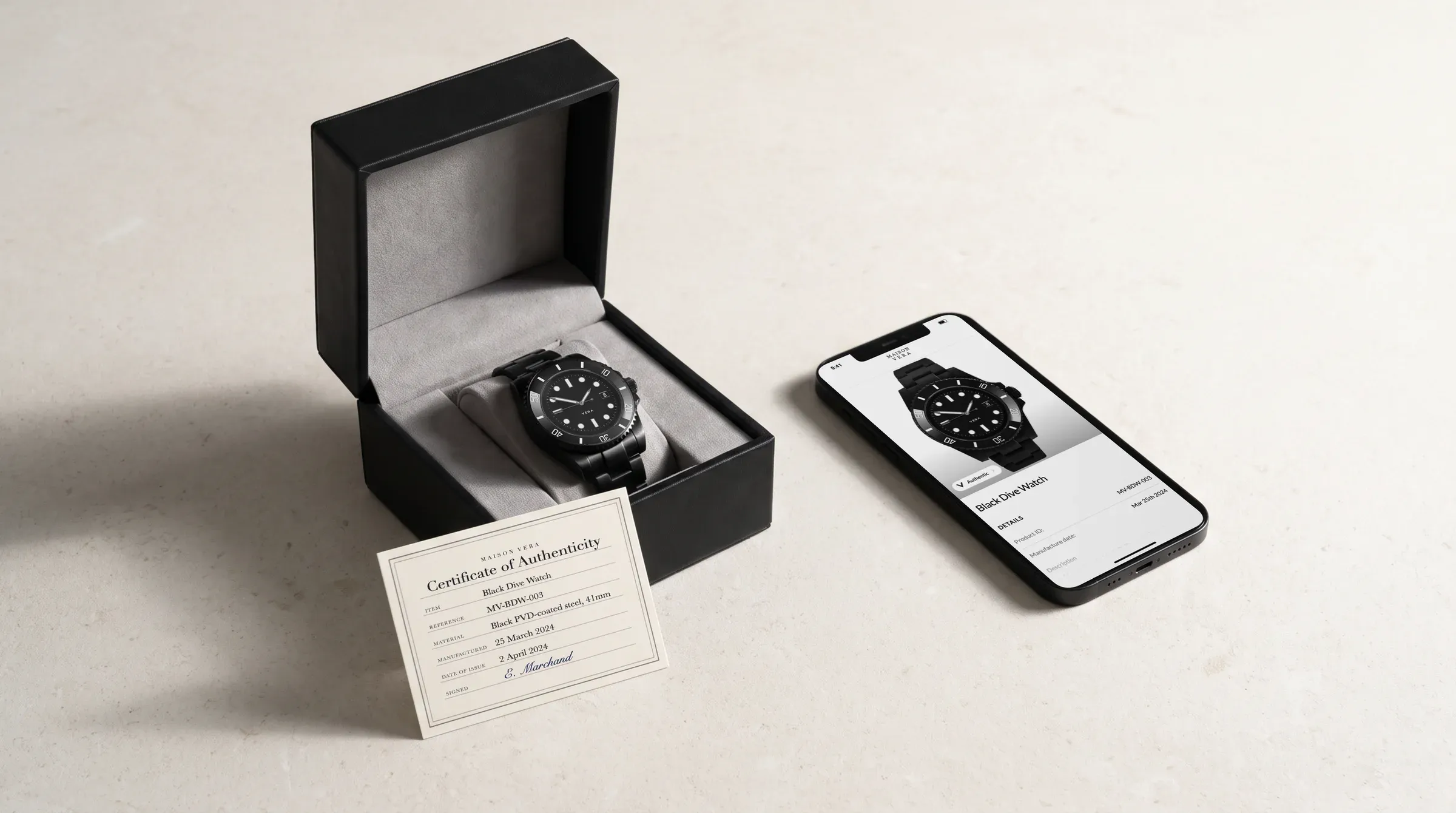
Vera works on the third of those fronts, records tied to the object. Each item carries a Vera tag, attached to the piece, its case or its mount, with a digital certificate behind it. The certificate holds the item's record: what was recorded when it was registered, and every change of ownership since.
Each tap computes a fresh code with a key that cannot be read off the tag, so a verified tap is evidence about the tag in hand, not just about a web address. A copied link or a screenshot opens the certificate without the verified state, and a tap that replays an old code is recorded as invalid and shown on the certificate, both to whoever is holding the item and to the issuer.
Decision
Does the proof belong to the item in your hands?
What is the item's proof?
A decision tree for a collector checking whether an item's proof belongs to the item in their hands. The first question is what the proof is. If it is a paper certificate, a sticker or a label, it travels separately from the item and is easier to copy than the item itself, so a reputable authenticator remains the right first step for any significant purchase. If it is a record tied to the object by a tag, the next question is how the certificate was opened. Tapping the tag shows it as verified, which is evidence about the tag in hand. A copied link or a screenshot opens it without the verified state. A tap that replays an old code is recorded as invalid and shown both to whoever is holding the item and to the issuer.
When the item is sold or given away, the certificate moves with it: the owner sends it on with a code, and on acceptance the ownership record changes hands. If an item is lost or stolen, the owner can mark it, and that status appears the next time anyone taps it. Over time the piece builds a chain of custody that travels with the object instead of in a folder.
A tag does not replace the expert. It cannot tell whether a signature was genuine when the item was registered; that remains the authenticator's job. What it does is keep the expert's work attached to the right object for the rest of its life.
Process
A chain of custody that travels with the object
The expert examines
Authenticating the piece stays the authenticator's job.
The item is registered
A tag on the piece, its case or its mount; the certificate holds what was recorded.
Every tap is checked
A fresh code each tap; a replayed code is recorded as invalid.
Ownership moves with it
Sent on with a code; on acceptance, the record changes hands.
A four-step chain of custody. First, an expert examines the piece; authenticating it remains the authenticator's job. Second, the item is registered: a Vera tag is attached to the piece, its case or its mount, and the certificate holds what was recorded. Third, every tap computes a fresh code, and a tap that replays an old code is recorded as invalid. Fourth, when the item is sold or given away, the owner sends the certificate on with a code, and on acceptance the ownership record changes hands.
Published by Vera, which makes product identity tags, certificates and software. Vera's own role is set out under 'Where Vera fits'.
This is for general information and is not legal advice.
New articles, interviews and product news from Vera.
Unsubscribe any time. We never share your email.
Explainer, 8 min read

Perspective, 6 min read
Perspective, 5 min read