
Published by Vera, which makes product identity tags, certificates and software. Vera's own role is set out under 'Where Vera fits'.
This is for general information and is not legal advice.
8 min read
Provenance is the documented history of an object's ownership and custody. Provenance research rebuilds that history one transfer at a time, and every gap in it raises a question.
Listen to this article
Definition
Provenance is the documented history of an object's ownership and custody: who has held it, when, and how it passed from one holder to the next. Museums also call it ownership history, because, as The Met puts it, objects always belong to someone. The Met describes provenance as an object's biography: its whereabouts in time and space.1
What does provenance mean in art? In practice, a museum's provenance for a work records who owned it, when and how each owner parted with it, and which collectors, dealers, agents and auction houses took part in each transfer. It usually notes where the work was exhibited, and where it was discussed and reproduced in print.1
The word is used well beyond paintings. A bottle of wine, a signed bat or a watch can have a provenance too: the chain of hands that connects the object in front of you to the moment it was made.
The record
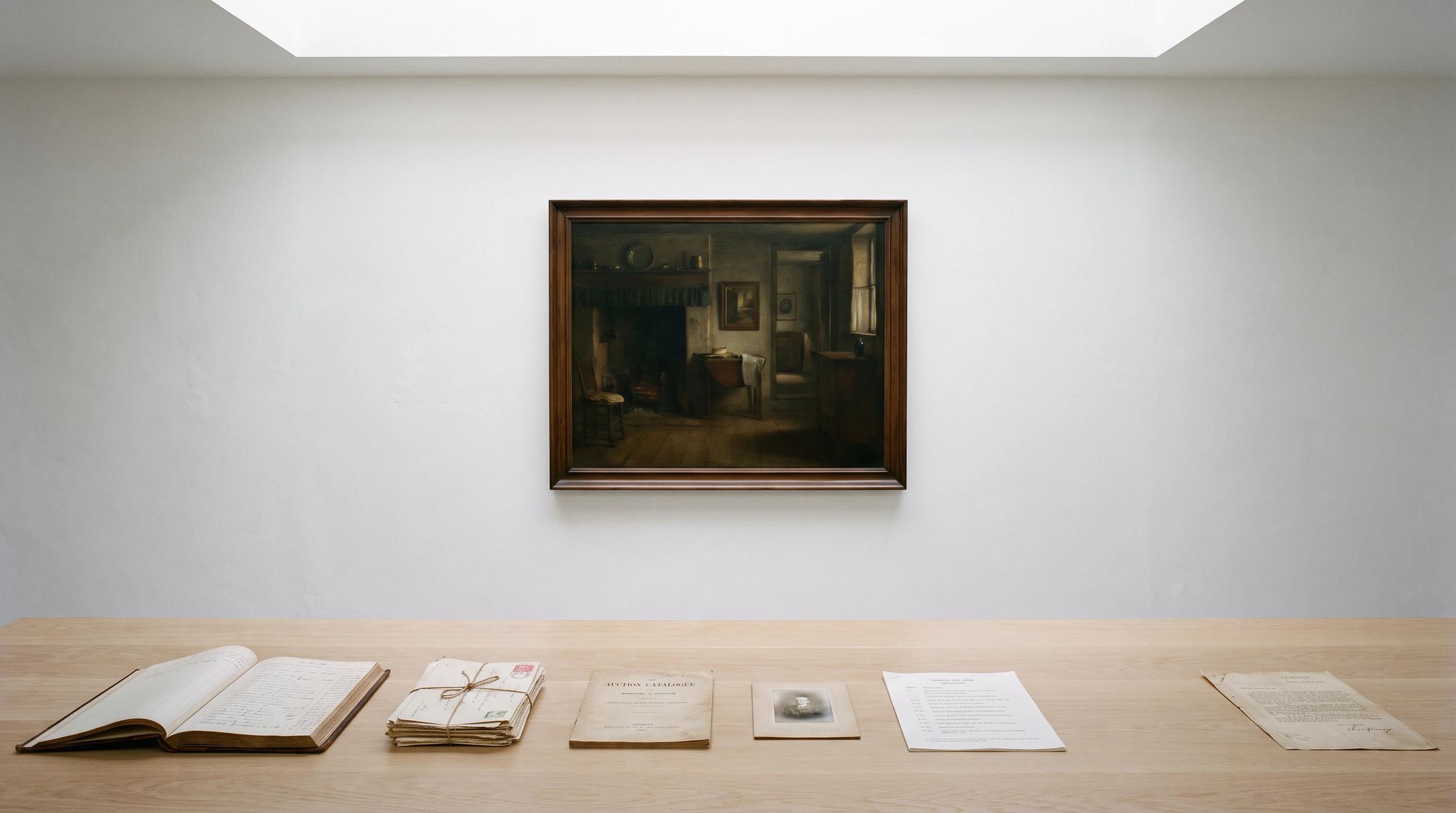
A provenance record is assembled from evidence that survives in many places, held by many people. The sources researchers name most often include:1,4
Each kind of document has its weaknesses. In one case study, The Met found a porcelain figure listed in a 1928 auction catalog under the wrong description, and a basket maker whose recorded name was probably a transcription error. A sticker inside the basket recorded where it was woven.2
Connections
One object's provenance, pieced together from evidence held in many places
A hub diagram with one object's provenance at the center, assembled from evidence that survives in many places and is held by many people. Around it, six kinds of source. Sale and auction catalogs, which can record the buyer and the price, though one 1928 catalog listed a porcelain figure under the wrong description. Dealers' records: stock books and stock cards, ledgers, memos and correspondence. Inventories, such as the legal inventories of private collections. Collectors' own papers, and photographs that show the object in a particular house or collection. Exhibition catalogs and published literature that list the object. And marks on the object itself, such as a label or sticker: one inside a basket recorded where it was woven.
An example
The Met publishes the provenance of works in its collection. Its record for Johannes Vermeer's Young Woman with a Water Pitcher, painted about 1662, begins with Robert Vernon of London, from 1801, a date the record marks as uncertain, until his death in 1849.3
At his estate sale at Christie's in London on April 21, 1877, the painting was sold to the dealer Colnaghi, cataloged as a work by Metsu rather than Vermeer. Viscount Powerscourt owned it in Ireland from 1878 until about 1887. It then passed through the dealers Agnew in London and Bourgeois Frères and Charles Pillet in Paris, and Pillet sold it in 1887 to Henry G. Marquand of New York. Marquand gave it to The Met in 1889.3
The record shows what provenance is made of: a sale under another painter's name, a chain of dealers, an owner's dates with a question mark. It also shows a limit. The first owner the record names appears more than a century after the painting was made.3
Timeline
One painting's documented chain of ownership, 1877 to 1889
Christie's, London
Sold on April 21, 1877, from Robert Vernon's estate, cataloged as a Metsu.
Viscount Powerscourt, Ireland
Owner from 1878 until about 1887.
Dealers, then Henry G. Marquand
Agnew, Bourgeois Frères and Charles Pillet; sold to Marquand in 1887, his until 1889.
The Metropolitan Museum of Art
Given by Marquand in 1889; in the collection since.
A timeline of the painting's documented owners from 1877 to 1889. On April 21, 1877, it was sold at Christie's in London from Robert Vernon's estate, cataloged as a work by Metsu. Viscount Powerscourt owned it in Ireland from 1878 until about 1887. In 1887 it passed through the dealers Agnew, Bourgeois Frères and Charles Pillet to Henry G. Marquand of New York, who owned it until 1889. In 1889 Marquand gave it to The Metropolitan Museum of Art, where it has been since.
Research
Provenance research rebuilds that chain one transfer at a time, and it is slow, specialized work. The American Alliance of Museums' standards for Nazi-era provenance set out the method in practical terms. Ask whoever is selling, lending or giving the object for all the provenance information they have. Search the institution's own records thoroughly. Then, where needed, contact archives, databases, dealers, auction houses, donors, scholars and other researchers. And document the research itself.5
Researchers at The Met describe documenting every step for a reason: so that the work can be picked up again when new archives open or new expertise appears. Large databases make that easier. The Getty Provenance Index, founded in 1974, holds over 12 million digitized resources from the 16th to the 20th centuries, drawn from inventories, auction catalogs and dealer stock books.1,4
Museums treat it as ongoing. MoMA's Provenance Research Project covers approximately 800 paintings created before 1946 and acquired after 1932 that were or could have been in Continental Europe during the Nazi era. The museum calls the research a work in progress and asks for any further information on the works.7
Why it matters
Provenance moves price and trust together. A desirable pedigree, such as ownership by a known connoisseur, adds cachet and increases an object's market value. Provenance also helps verify attribution and authenticity, for instance when a painting can be traced back to the artist's own dealer. And it is how a buyer knows the seller had the right to sell.1
That is also why a false provenance is worth forging. The story attached to an object can be worth more than the object.
Gaps are normal. The older the object, The Met notes, the likelier it is that some periods are undocumented. But a gap is also where a theft, a forced sale or an illegal export can hide, and the reason a museum checks is to make sure that good title passed with every transfer.1
The standards of the American Alliance of Museums (AAM) ask museums to try to resolve an object's Nazi-era provenance before acquiring it, and to give reasonable consideration to gaps and ambiguities, given how much documentation from those years was dispersed or lost. From 2003 to 2024, US museums listed objects that changed hands in Continental Europe between 1933 and 1945 on a shared registry, the Nazi-Era Provenance Internet Portal. When it was archived in July 2024, it held records for nearly 30,000 objects from 179 museums.5,6
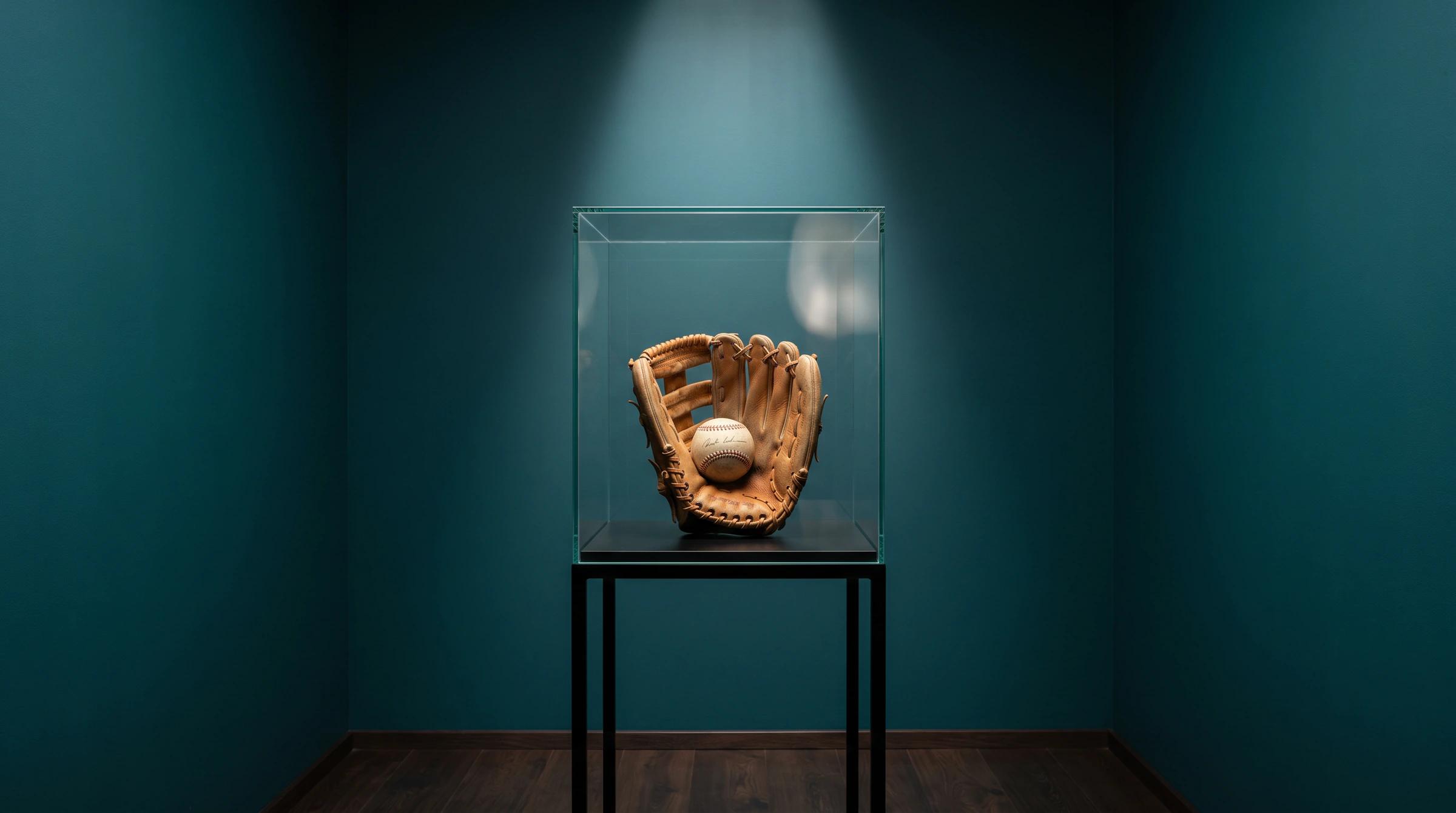
Gaps also leave room for stories. In June 2026, a California memorabilia dealer was sentenced for wire fraud in a scheme in which, prosecutors said, he doctored items and gave them false provenance. He admitted that a bat he had sold one buyer for $100,000, as one used in the 1954 World Series, had not been used in it; it was a factory error bat.9
Wine shows the same weakness from another side. A US wine dealer convicted in December 2013 had blended cheaper wines, poured them into empty bottles of rare wines, sealed them with corks and fitted counterfeit labels, then sold them at auction and directly to collectors from 2004 through 2012. The bottles were genuinely old. What was inside them, and the history they implied, were not.8
Paper and digital
Paper provenance is reconstructed after the fact, from documents that were never designed to be read together. An item-level digital record works the other way round: one record belongs to one object from the start, and each transfer is added to it when it happens. The record still has to be tied to the object, or it is only another document that can travel without it.
Comparison
Paper provenance is reconstructed; an item-level record is written as it happens
Paper provenance
Where it lives
Spread across catalogs, dealers' books, archives, labels and letters
When it is written
Pieced together afterwards by research, sometimes generations later
How it fails
Gaps, misdescribed lots, transcription errors, invented stories
Who can check it
Researchers with access to the archives
An item-level digital record
Where it lives
One record for one object, linked to an identifier on the object
When it is written
At each transfer, as it happens
How it fails
Breaks if the record can be detached from the object, or the link copied
Who can check it
Anyone holding the object who can read its identifier
A comparison of paper provenance and an item-level digital record. Where it lives: paper provenance is spread across catalogs, dealers' books, archives, labels and letters; an item-level record is one record for one object, linked to an identifier on the object. When it is written: paper provenance is pieced together afterwards by research, sometimes generations later; an item-level record is written at each transfer, as it happens. How it fails: paper provenance has gaps, misdescribed lots, transcription errors and invented stories; an item-level record breaks if it can be detached from the object or its link copied. Who can check it: paper provenance, researchers with access to the archives; an item-level record, anyone holding the object who can read its identifier.
Checklist
Where Vera fits
Vera keeps provenance as a record for each item, written as it happens. A Vera Tag gives the object its identity, and tags can be bound to their products before a box leaves the maker, so the record starts at the source rather than with the first collector.
From there, every transfer, scan and resale is written to the item's one certificate, so the record outlives every owner. A tap opens it in the phone's own browser, with no app. Each owner decides whether their own step shows in the public provenance history, and can change that decision at any time. An item reported lost or stolen carries that state on its record. A copied link is recorded as an invalid scan, so a copy of the link is no longer enough to pass for the original. If a tag is damaged, it is replaced and the certificate rebound to the new one, and the history stays whole.
Published by Vera, which makes product identity tags, certificates and software. Vera's own role is set out under 'Where Vera fits'.
This is for general information and is not legal advice.
Questions
Explainer, 8 min read
Perspective, 7 min read
Perspective, 4 min read